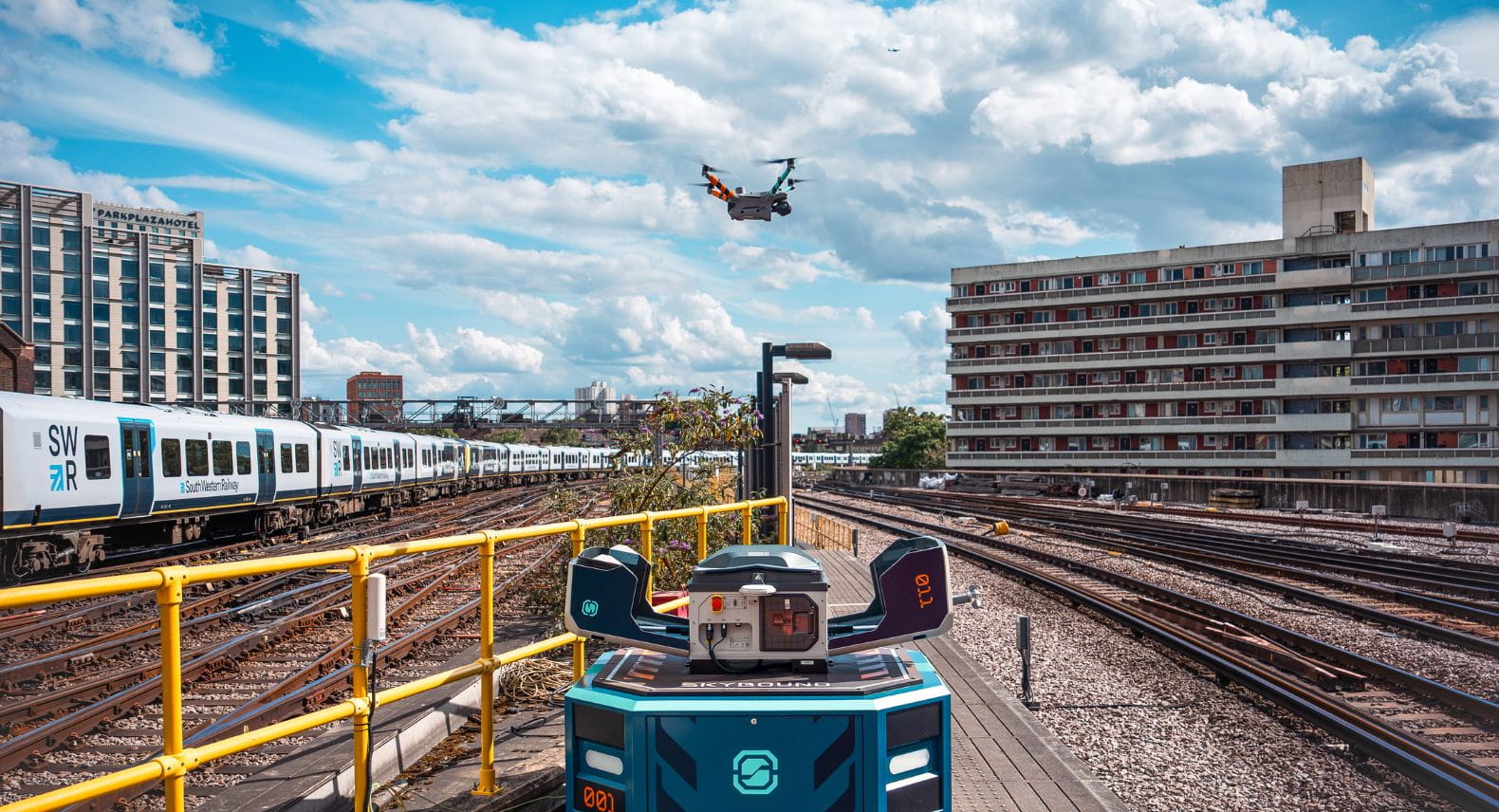
RAILWAY customers at London Waterloo may have spotted a new presence overhead: a drone helping to prevent delays at Britain's biggest station.
South Western Railway (SWR) and Network Rail Wessex (NR Wessex) are deploying automated drone technology to deter and tackle trespass, improve safety and reduce disruption on one of the country’s busiest rail corridors.
Trespassing on the railway is illegal and extremely dangerous. SWR and NR Wessex trains are powered by an 'always on' electric third rail carrying 750 volts of direct current, which can cause severe, lifechanging injuries or death.
When trespass is reported on the railway, SWR and NR Wessex must turn off the power, preventing trains from running until the incident has been resolved and power to the lines can be safely restored.
Most of South Western’s 1,600 daily services begin or end at London Waterloo. Even minor incidents can delay thousands of customers and cost taxpayers millions.
Between April 2025 and June 2026, trespass and fatalities caused almost 14 per cent of cancellations and over 200,000 minutes of delay to SWR and NR Wessex services, making it one of the leading causes of disruption.
Last September, a trespasser near Clapham Junction caused more than 57 hours of delays and was later imprisoned for eight weeks.
Another even more serious incident in the New Malden area in August 2024 saw the equivalent of nine days of delays, costing the taxpayer £1.2 million. The trespasser was sentenced to 18 months in prison.
The drone is operated remotely by British firm SkyBound from a high-tech control centre almost 80 miles away in Woolston, in the Southampton area.
When required, operators launch the drone from its trackside station to provide rapid intelligence for SWR and NR Wessex's control centre, security and engineering teams, even before teams arrive on the ground.
Its high-resolution and thermal imaging cameras give enhanced visibility of trespass incidents, infrastructure concerns or any situation that requires inspection, with live footage streamed directly to the network’s operations centre in Basingstoke.
This allows the railway and emergency services to respond more quickly, reduces the need for ground teams to access the track, and limits the need to switch off the power and delays customer journeys.
The drone at Waterloo is just the first of a planned chain of SkyBound drones to help protect the busiest section of the SWR and NR Wessex network, with further drones to be based at Clapham Junction, New Malden and Walton-on-Thames.
Tom Desmond, Operations Director for South Western Railway and Network Rail Wessex, said:
“Trespass is one of the leading causes of disruption on our network, delaying our customers' journeys and costing taxpayers. Every minute of delay at London Waterloo also has a significant impact on our wider network.
“By providing rapid, live intelligence from the air, this drone helps us respond more quickly to incidents, enhance safety and keep trains moving along one of the country's more important railway lines.
“It's an exciting use of innovative technology between South Western Railway, Network Rail Wessex and our partners at SkyBound and part of our plan to give customers more reliable journeys.”
Rail Minister, Lord Hendy said:
“Publicly owned operators like South Western Railway are utilising the latest tech to prevent disruption.
“Trespassing on the tracks is dangerous — it put lives at risk and costs taxpayers money. Under Great British Railways we're bringing track and train together to tackle this persistent issue and keep journeys running smoothly.”
Gemma Alcock, Founder and CEO of SkyBound, said:
“London Waterloo is exactly the kind of complex environment where automated drone operations can make a practical difference. From our control centre in Woolston, SkyBound is helping turn drone capability into a reliable operational service for critical infrastructure, giving railway teams faster access to visual and thermal information when it matters.
“This is about more than a single drone at a single station. It is about building the model for rapid response and more persistent awareness across key rail corridors, so teams can better understand incidents, inspect assets, gather evidence and make informed decisions in high-pressure environments.
“The aim is simple: to help keep people safe, reduce disruption and give railway teams better information when it matters most.”
To be authorised for use at London Waterloo, the fully licenced drone has passed rigorous safety checks, only operates within set railway boundaries and adheres to strict privacy standards.
Drones are just one example of publicly owned SWR and NR Wessex using innovative technology to prevent disruption and deliver improvements for customers ahead of the formal establishment of Great British Railways by the end of 2027.
In autumn 2025, two thermal imaging cameras were installed on a longer-distance Class 450 train to constantly monitor track conditions for potential faults.
Since deployment, the train known as Hotshot has detected 21 high-risk hotspots across 12 locations, allowing engineering teams to address emerging defects early and limit disruption to customers.
In early 2026, Hotshot helped engineers detect and address a fault in the Waterloo area which otherwise could have caused 2,000 minutes of delay and cost the railway and taxpayers up to £200,000.
Anyone who witnesses trespassing on the railway is urged to contact British Transport Police by texting 61016 or calling 999 in an emergency.