At South Western Railway we know that you want a safe, reliable, punctual service. We’re committed to providing this, to help deliver the best service we can.
We continually measure our service reliability and punctuality and report on how we are performing against targets which are set in our Passenger’s Charter.
All our services are monitored every day, including Sundays and Bank Holidays and we have a range of performance activities taking place to improve our network. Here are a few things we are doing this year:
- Continuing to rollout the Arterio trains to replace the suburban fleet.
- £129m investment in the re-signalling from Farncombe to Petersfield, including the renewal of nine level crossings.
- Queenstown Road Track Renewal to remove multiple reoccurring faults in the area.
Want to know more about what we're doing to improve performance?
Download our Joint Performance Strategy with Network Rail, delivering a high performing railway, together.
Headline Performance data — Period 4 (28 June - 25 July)
The rail year runs from 1st April to 31st March and is split up into 13 four-week ‘periods'.
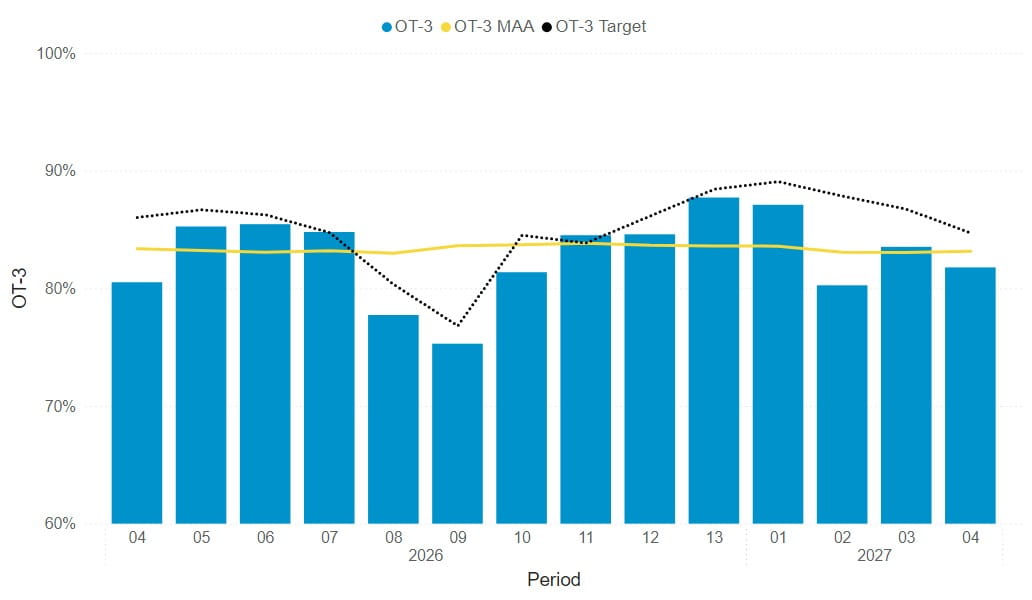
Percentage of total services cancelled
PERFORMANCE TARGET FAILURE EXPLANATION
Reporting Period: P04
Performance Target: Operational Performance – Punctuality
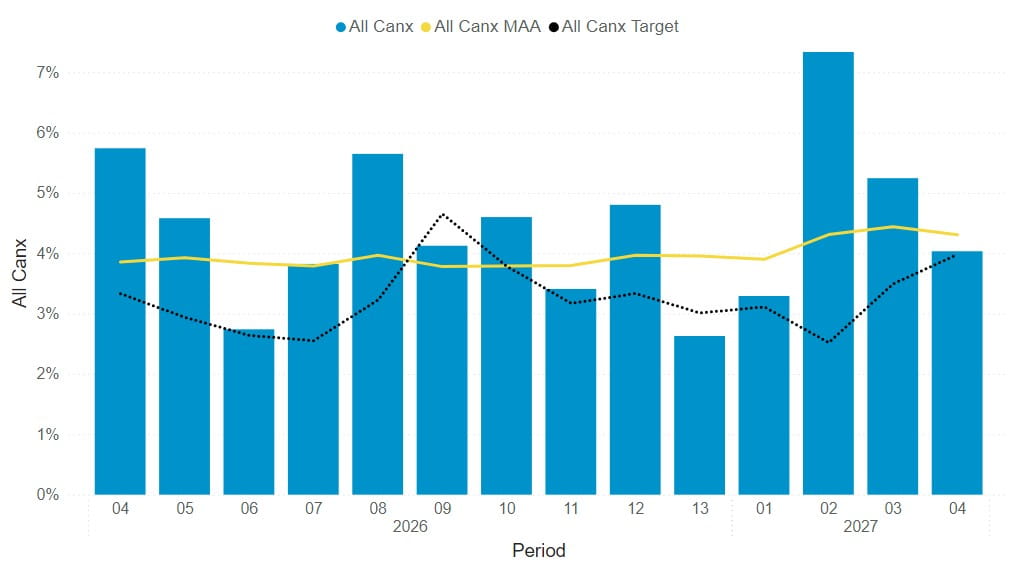
Target: 83%
Actual Performance: 81.8%
Variance: -1.2%
Summary
The Operator did not achieve the Punctuality Operational Performance Target during Period 4, achieving 81.8% against a target of 83.0%.
Cause(s) of the relevant Performance Target Failure:
The principal causes of the failure were Fixed Infrastructure, Weather, Fleet, and External Factors.
Fixed Infrastructure was the largest contributor to the target miss. Third Rail Faults accounted for over half of the variance, driven almost entirely by the prolonged impact of a New Milton substation fire on 8th July. Vegetation Management was also a significant challenge, primarily due to the Barnes tree on the line incident on 2nd July, alongside several smaller events throughout the period.
Weather-related impacts were driven by a combination of widespread lineside fire incidents (including at New Milton substation and Woking), Critical Rail Temperature speed restrictions, and a heat related restriction at Woking 2236 points.
Fleet performance was worse than target, and the impact of Arterio fleet failures remained a significant contributor to OT3 underperformance, with the operation of these services on the route's most critical locations often amplifying the performance impact.
External Factors were driven predominantly driven by trespass and disorder incidents with two significant trespass events at Waterloo and Barnes Bridge accounting for most of the delays.
Actions to Remedy Failure:
- We are investing in improved technologies to provide remote visibility of fixed infrastructure (such as on train detection technology), particularly in hot weather, which will help maintenance teams prioritise tasks and upskilling colleagues to help reduce the time it takes to rectify faults.
- We continue to see improvements in Arterio fleet performance and expect performance and reliability to improve, in line with the performance improvements seen on other new rolling stock fleets over the course of their introduction to service.
- We are continuing our engagement with the British Transport Police, the Samaritans, local authorities, and other organisations to mitigate trespass and fatalities. We have also commenced work on high-risk boundaries and platform ends, following a survey of 203 stations, to help prevent unauthorised access to the railway. We are also deploying additional colleagues at key locations, both on trains and at stations, to further prevent unauthorised access to the railway.
Notice to Improve Performance
A Notice to Improve Performance has/has not been issued by the Secretary of State in respect of this Performance Target Failure.