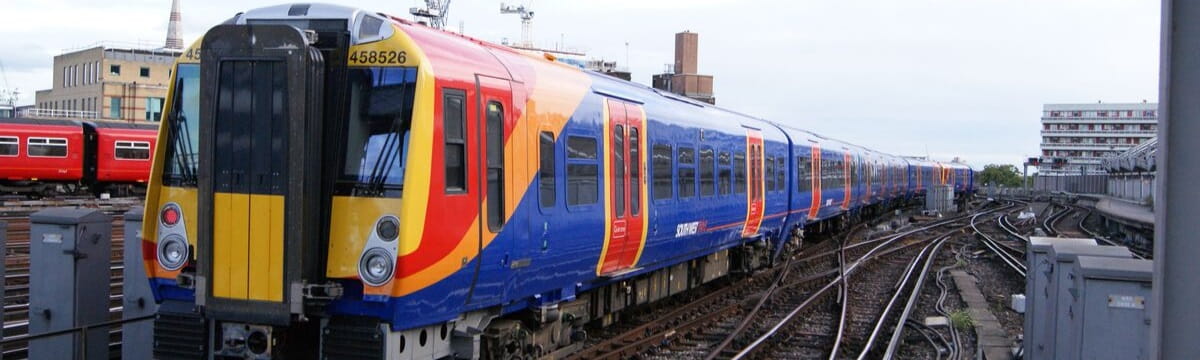
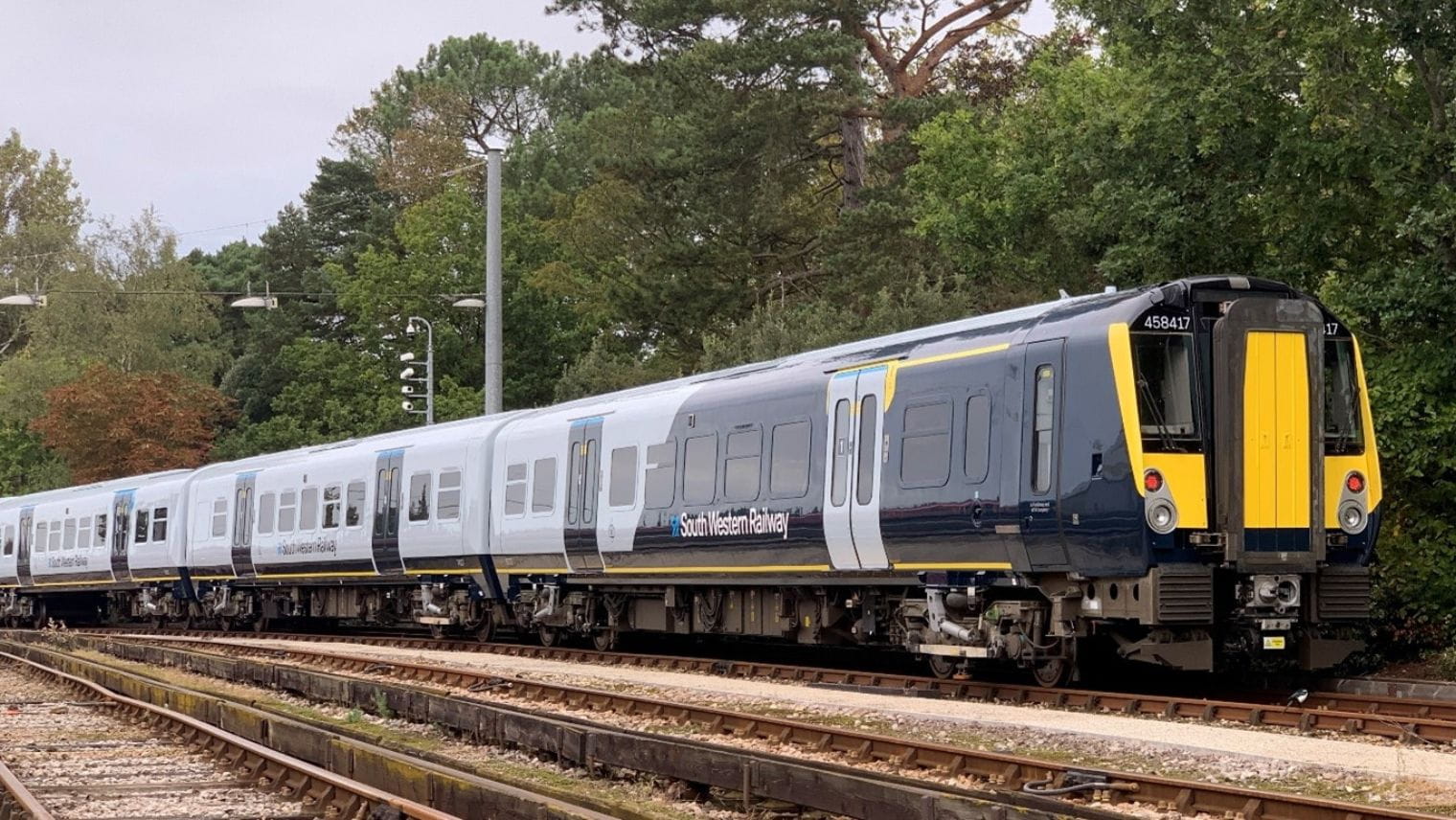
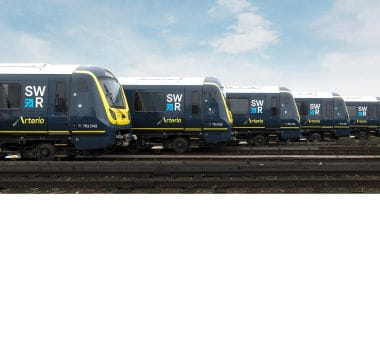
The Class 458/4s trains are four carriage trains developed from our previous four-carriage Class 458 trains.
You'll commonly find them on routes between:
London Waterloo and Reading
London Waterloo and Windsor & Eton Riverside
London Waterloo and Hounslow (via Brentford and via Richmond)
London Waterloo and Weybridge (via Brentford)
Built by Alstom GEC, the original four-coach Class 458 fleet came into service in 2000 to replace many of the British Railway ‘slam door’ trains.
They were later returned to their manufacturer, and with the Class 450 Desiro fleet being introduced in 2004, were re-leased by the then-South West Trains.
Following significant work at our Wimbledon depot the trains became some of the most reliable in the UK, winning a number of awards.
A refurbished Class 458/4 train
The four-carriage 458s then became Class 458/4 trains, while the remaining five-carriage units became Class 458/5 trains. Following a refurbishment 28 class 458s were converted from five to four carriages in length and became Class 458/4s, for use on some suburban routes as we rolled out our new Arterio trains.
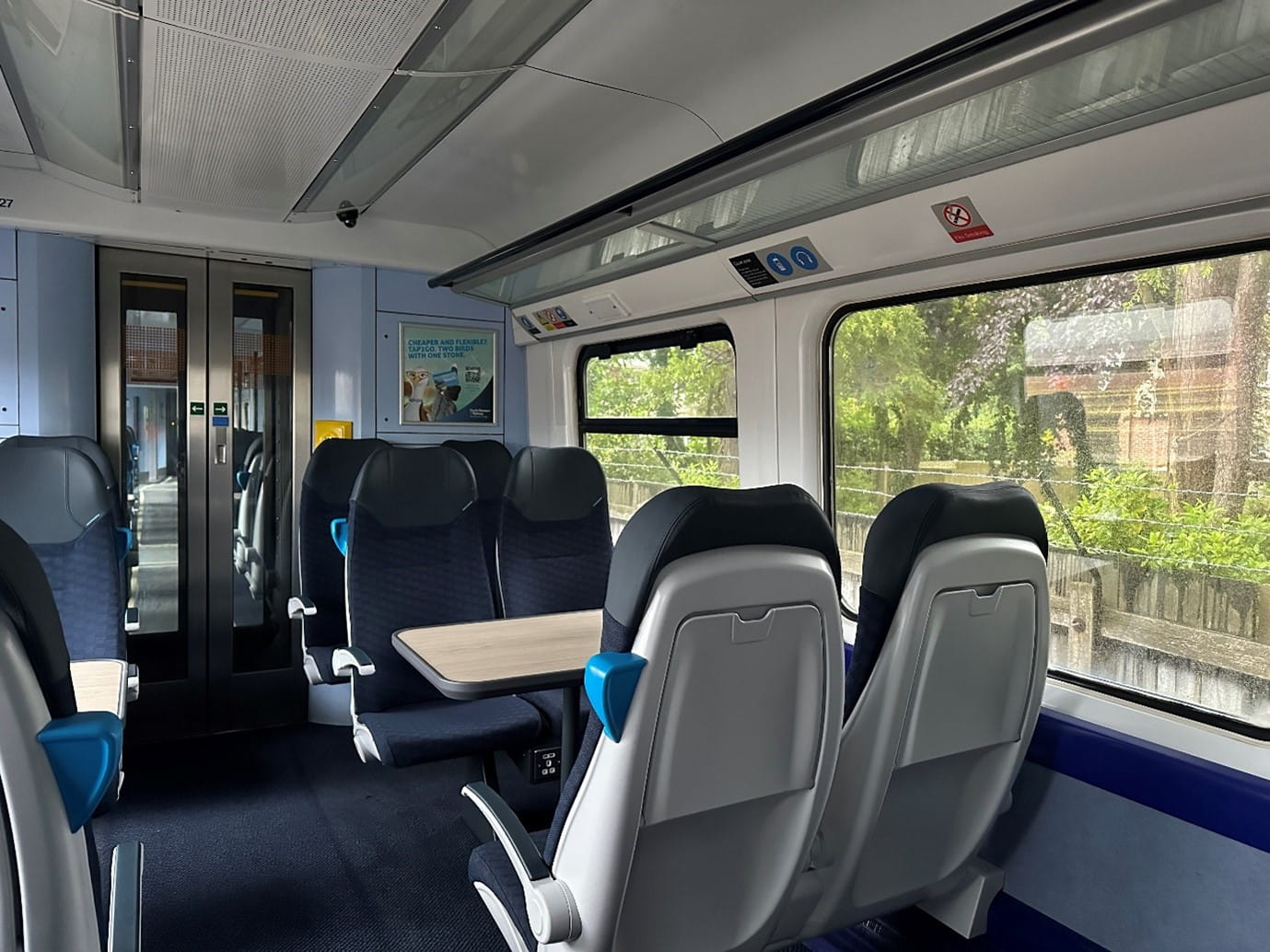
Interior of a Class 458/4
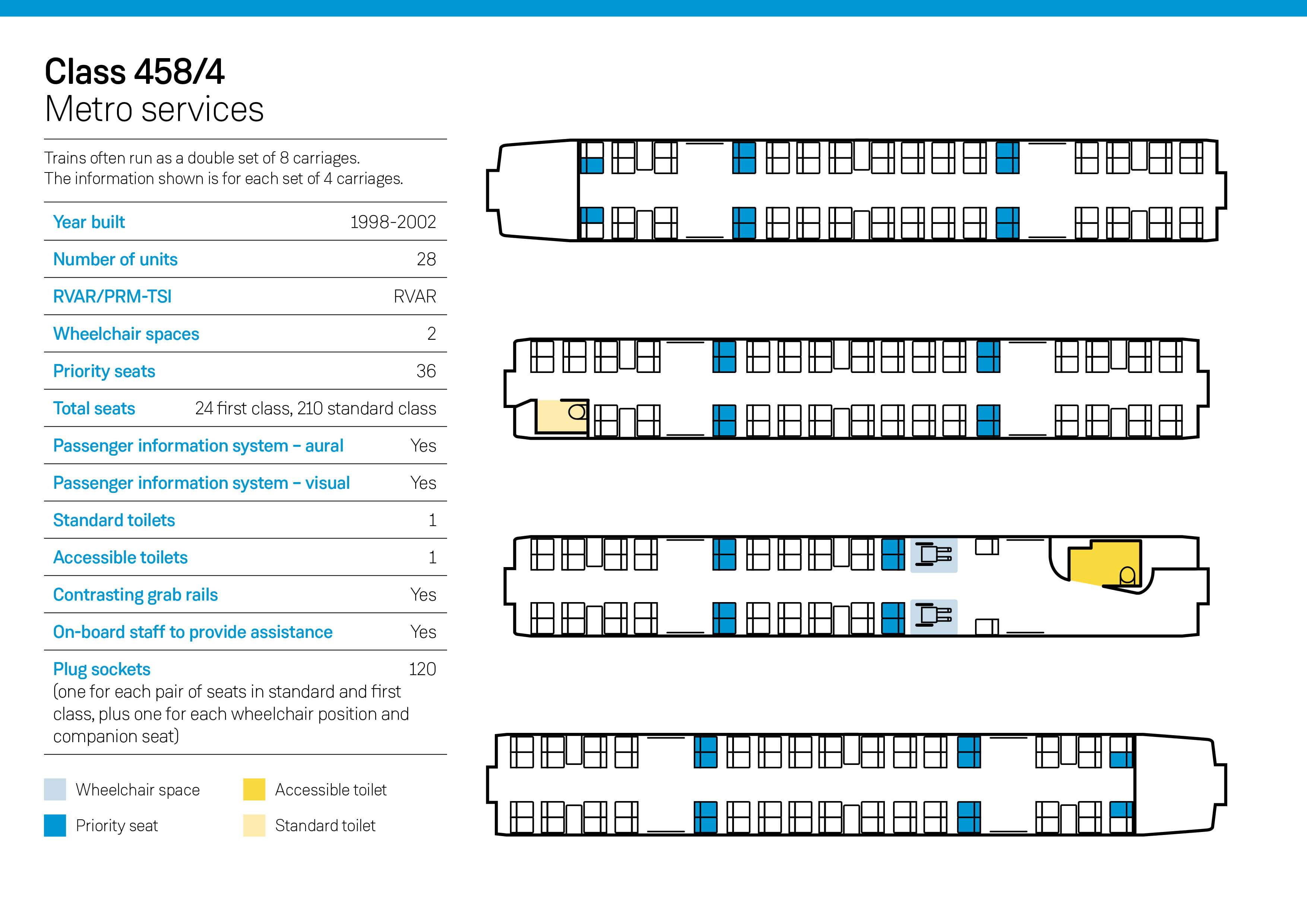
Class 458/4 Train plan
How many seats does a Class 458 have?
A Class 458/4 has 234 Standard Class seats. There are two First Class compartments with 12 first class seats, however, first class has been declassified for the time being.
How many cycles can a Class 458 carry?
A class 458/4 does not have space for cycles
How many wheelchair users can travel on a Class 458?
Two wheelchair users can travel safely on a Class 458/4.
What accessible features does the Class 458 have?
Our Class 458 trains have:
For physically disabled people:
Power-operated external doors, which contrast with the rest of the train. They're at a height where they can be used by a wheelchair user on the platform easily.
Large external door operation buttons, with what the button does clearly marked in English and Braille. They contrast with the door and light up when active.
Gender-neutral lavatories are provided on the train. An accessible lavatory with call-for-aid buttons at floor level and adequate room to move a wheelchair or scooter can be located in the area for wheelchair users. There are also handholds and a low-level sink with motion-activated water and dryer.
Call for aid buttons near each wheelchair position, with direct communication to the driver.
An on-board ramp with locking pins for the train that the crew are trained to deploy. The gap between the train and platform can often be difficult for wheelchair users and customers with limited leg and upper body strength. Assistance joining and leaving the train is available from the crew.
For D/deaf, hard-of-hearing, and sound-sensitive people
Assistance dogs are welcome on board but must be kept on a lead.
An on-board audiovisual announcement system in English. This system issues the stations where the train stops, as well as security and safety messages. The system can be overridden by the on-board crew.
A quiet carriage.
Our crew all carry smartphones, which you can use for alternative forms of communication if needed.
For blind, partially-sighted people, and photosensitive people
Assistance dogs are welcome on board but must be kept on a lead.
Large external door operation buttons, with what the button does clearly marked in English and Braille. They contrast with the door and light up when active. A chime will also sound when the doors have been activated, and an alarm will sound when they are closing.
Unfortunately the nature of how our trains are powered means that we can't guarantee lighting will be flicker-free. Warm fluorescent lighting is used throughout, with light diffusers.
For Autistic, anxious and Neurodiverse people
Assistance dogs are welcome on board but must be kept on a lead.
We welcome anxious or nervous travellers to try the train with us before making a journey. Our ambassador team will happily support individuals or groups at a station, navigating buying tickets, boarding trains, travelling, and seeking help if you need it.
Our crew all carry smartphones, which you can use for alternative forms of communication if needed.
For people with severe allergies or who are immunocompromised
Our heating and cooling systems are roof-mounted on the train. We're not able to turn these off except in emergencies.
You're welcome to use a safety/particulate mask on board if you need to.
Class 458/4 unit image: Ashley Frost/SWR
Class 458/4 interior image: Ashley Frost/SWR