- New data from South Western Railway (SWR) has revealed three-fifths (59%) of Brits would negatively judge[1] someone if they were caught intentionally avoiding paying a railway fare
- SWR has launched a campaign to raise awareness of the repercussions of fare evasion - which range from prison sentences to feelings of stress and embarrassment
- Fare evasion costs Britain’s railways an estimated £350-400 million annually[3]
New research has revealed three-fifths (59%) of Brits would judge*[1] someone negatively if they were caught intentionally fare dodging. The study, commissioned by South Western Railway (SWR), explores the reality of not paying the right fare at a time when fare evasion and ticket fraud at a national level is estimated to account for at least £350 to 400 million of lost revenue each year[3].
Being caught for fare dodging can lead to fines of up to £1,000, a criminal record and even a prison sentence. When asked which of the potential consequences would discourage them from fare evasion - three quarters (75%) agreed a prison sentence was a strong deterrent[4], and a fine of up to £1,000 would make 71% think twice before intentionally fare evading [5].
Interestingly, the study also examined the emotional consequences of being caught. 45% said ‘the embarrassment of being caught and questioned in public’ [6] and ‘the stress or anxiety of getting caught’ would be a strong enough deterrent to make sure they paid the right fare [7].
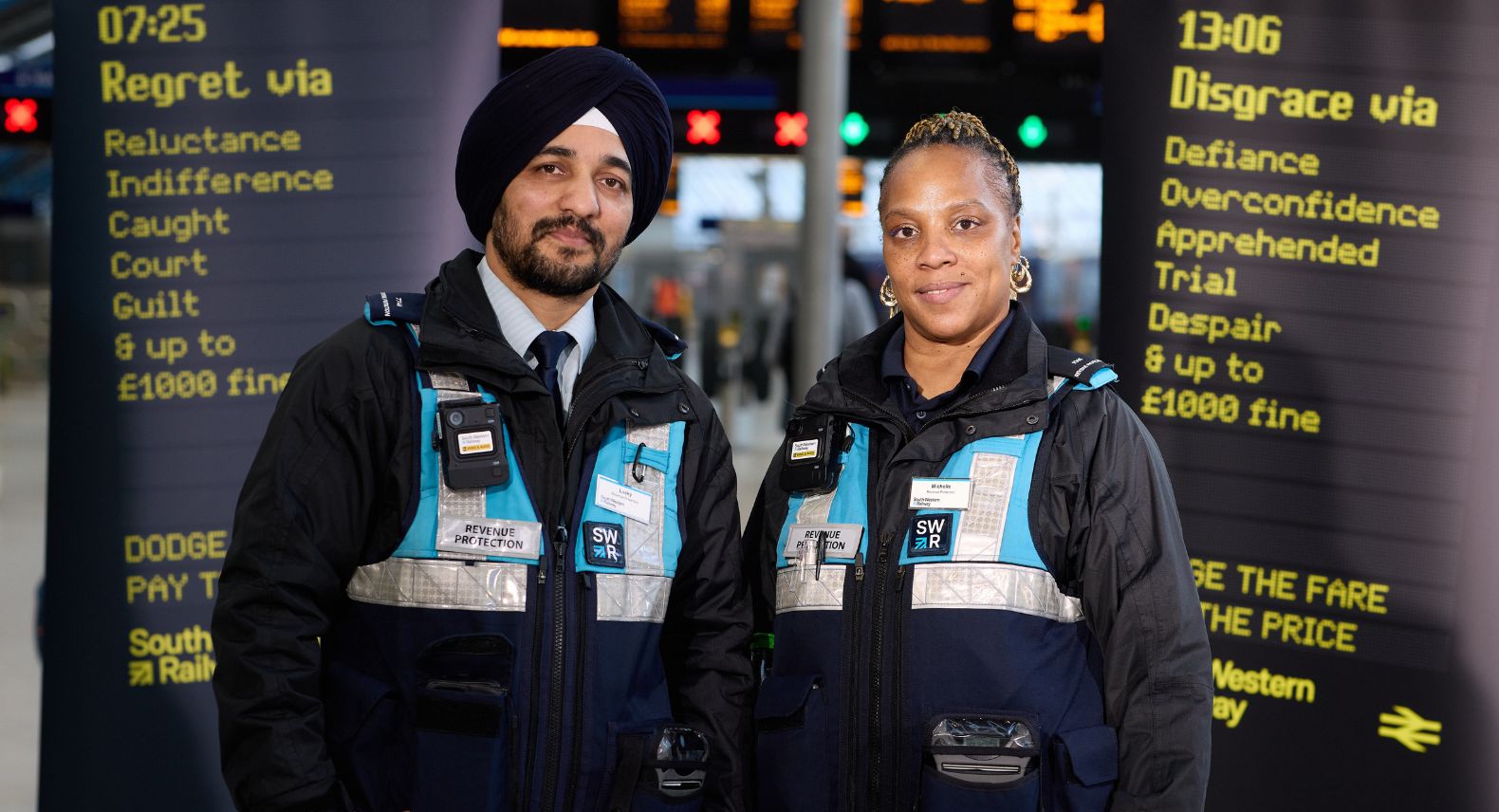
Last year, SWR surveys identified a potential £45.5m in annual revenue at risk to fare evasion, causing the operator to launch a new campaign tackling the issue. The eye-catching posters at stations across the network highlight the consequences of travelling without a ticket or with the wrong ticket, showing a departure board calling at ‘Indifference, Caught, Court, Guilt and Up to £1,000 Fine.’
In June 2025, The Office of Rail and Road (ORR) released a report into Revenue Protection practices, which found: “given the scale of fare evasion and the impact it has, it is right that there are sanctions in place to deter or punish those who deliberately evade their fare.”[8]
The campaign launch follows the release of Channel 5’s behind-the-scenes documentary, ‘Fare Dodgers: At War with the Law’, which premiered earlier this year. The documentary followed the commitment and hard work of South Western Railway’s revenue protection teams and lifted the lid on its efforts to reduce fare evasion, making train travel fair for fare paying customers.
Peter Williams, Customer and Commercial Director at South Western Railway adds:
“It’s always interesting to see what motivates people to do the right thing. While a prison sentence is unsurprisingly a strong deterrent, the research clearly shows that being caught fare dodging can also have an emotional impact.
“The majority of our customers pay the correct fare, and we recognise that genuine mistakes can happen. However, there is growing evidence of some individuals deliberately evading payment - a criminal offence that costs the railway hundreds of millions of pounds each year. We have a responsibility to safeguard ticket revenue so that it can be reinvested into delivering the best possible service for our passengers including the roll out of new fleets.”
Notes
All figures, unless otherwise stated, are from YouGov Plc. The total sample size was 2062 adults. Fieldwork was undertaken between 21st - 22nd October 2025. The survey was carried out online. The figures have been weighted and are representative of all UK adults (aged 18+).
[1] Q. To what extent, if at all, would your opinion of someone change if they were caught intentionally avoiding paying a railway fare? Net negative: 59%
[2] Q. To what extent, if at all, would your opinion of someone change if they were caught intentionally avoiding paying a railway fare? Net negative: 59%
[3] Source: Independent review of train operators' revenue protection practices, June 2025. 1.28 An updated estimate from earlier this year (from the Rail Delivery Group (RDG), GBR Transition Team and DfT) indicates that fare evasion and ticket fraud accounts for at least £350 to 400 million of lost revenue each year. Anecdotally, some industry stakeholders have told us that they believe the actual level of fare evasion is somewhat higher.
[4] Q. On a scale of 1 to 5, with 1 being 'Not a deterrent at all' and 5 being 'A strong deterrent', how much would each of the following potential consequences discourage you from fare evasion? Prison sentence - Strong deterrent: 75%
[5] Q. As above. Fine of up to £1,000 - Strong deterrent: 71%
[6] Q. As above. The embarrassment of being caught and questioned in public - Strong deterrent: 45%
[7] Q. As above. The stress or anxiety of getting caught - Strong deterrent: 45%
[8] Source: Independent review of train operators' revenue protection practices, June 2025. 1.29 Given the scale of fare evasion and the impact it has, it is right that there are sanctions in place to deter or punish those who deliberately evade their fare.